An examination of Ohio Supreme Court Fourth Amendment decisions over the past decade reveals consistent patterns in the Court’s analytical approach. A review of nineteen cases decided between 2016 and 2026 revealed that seventy-four percent (74%) were decided in favor of the State, while twenty-six percent (26%) favored the defendant. To determine whether any patterns accounted for this disparity, Ohio Court Watch analyzed the decisions.
The Fourth Amendment protects privacy, a strongly held value in a democratic society, and one that is increasingly being tested in an interconnected, technologically driven world. Well before the advent of the digital age, the Fourth Amendment was introduced in 1789 as part of the Bill of Rights and was officially made part of the United States Constitution in 1791. It states:
The right of the people to be secure in their persons, houses, papers, and effects, against unreasonable searches and seizures, shall not be violated, and no Warrants shall issue, but upon probable cause, supported by Oath or affirmation, and particularly describing the place to be searched, and the persons or things to be seized.
The Fourth Amendment did not initially apply to state actors. That changed with the United States Supreme Court’s 1961 Mapp v. Ohio decision. This case addressed whether evidence obtained through an unreasonable search and seizure is admissible in state court for state offenses. In Mapp, police forcibly entered Dollree Mapp’s home without consent and, falsely claiming to have a warrant, seized materials used to convict her of possessing obscene items. The Ohio Supreme Court upheld her conviction, despite acknowledging the evidence was obtained unlawfully. The U.S. Supreme Court ultimately reversed, holding that illegally obtained evidence by state officials is inadmissible in state court. Relying on Weeks v. United States, the Court reasoned that exclusion of illegally obtained evidence served as the most effective incentive to deter state officials from unreasonable search and seizures. In this article, Ohio Court Watch examines this deterrence rationale through a review of prior Fourth Amendment decisions from the Ohio Supreme Court.
A defendant alleging an unlawful search or seizure bears the burden of establishing a Fourth Amendment violation. Upon review of the nineteen Ohio Supreme Court Fourth Amendment cases from the past ten years, their data could be analyzed through various lenses and structures. To capture the dataset’s dominant themes, the cases’ central questions can be categorized into one of four types—public safety, probable cause/reasonable suspicion, consent, or warrant/procedural.
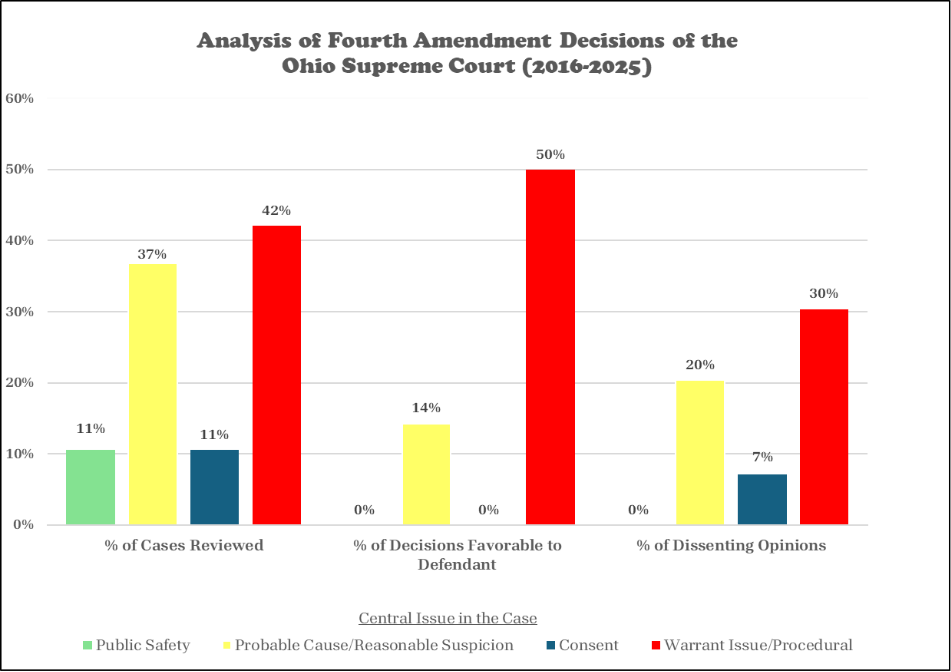

Under this categorization, the majority of outcomes were favorable to the State. As noted below, the decisions in favor of the defendant were usually a result of a warrant issue or procedural error.
The Lowest Rates of Dissent: Public Safety Considerations
The cases with the lowest rates of dissent were those involving public safety and consent. For example, in the 2017 decision in of State v. Polk, the Court unanimously held that a school employee’s warrantless search of an unattended bookbag, pursuant to school protocol to determine the owner and whether the contents were dangerous, was not a violation of the student’s Fourth Amendment rights, because the search furthered a compelling governmental interest in protecting public-school students from physical harm.
Similarly, in the 2021 decision in State v. Tidwell, a police officer stopped the vehicle of Sherry Tidwell at a Speedway gas station, when a customer inside the store yelled out to the officer that Tidwell was drunk. The trial court ultimately suppressed the evidence from the investigatory stop, concluding that the stop was unjustified because Tidwell had not been involved in an accident, her driving was not erratic, and the anonymous tip from the unidentified Speedway customer was “essentially unreliable.” However, under Terry v. Ohio, a police officer who lacks the requisite probable cause consistent with the Fourth Amendment, may make an investigatory stop of a person if the officer has reasonable suspicion to believe that the person is or is about to be engaged in criminal activity. In Tidwell, the Ohio Supreme Court unanimously held that, under the totality of the circumstances, including the public safety concern of allowing an allegedly intoxicated driver to enter a busy roadway, the officer had reasonable suspicion to initiate a Terry stop and thus did not violate the Fourth Amendment, permitting the evidence to be admitted.
Consent Searches: A Traditional Case and a Brief Look at Emerging Tech Issues
Two cases questioned the defendant’s consent to search. In its 2022 decision in State v. Campbell, the Court held that Campbell, who had been released from prison for robbery, did not suffer a Fourth Amendment violation when he agreed to the terms of community control, including warrantless searches of his person and property at any time. During one of those random home searches, officers discovered child pornography on Campbell’s cell phone and seized several other electronic devices, ultimately leading to nine felony charges against Campbell. The Court concluded that the search fell within the scope of the conditions to which Campbell had consented.
Consent issues have become more complex as Fourth Amendment disputes move into the digital realm. In its 2025 decision in State v. Diaw, the Ohio Supreme Court unanimously held that an individual has no reasonable expectation of privacy when voluntarily sharing location information to a third party. The Court reasoned that when using an online-marketplace app to list a laptop for sale, Diaw knowingly provided his location to the platform. After Diaw allegedly robbed and assaulted the victim during an in-person meeting for the sale of the laptop, law enforcement subpoenaed his location data from the app to determine where the app had been used. Because Diaw voluntarily conveyed this information, the Court concluded that obtaining it without a warrant did not violate the Fourth Amendment.
Where the Court Focused Its Review: Probable Cause and Reasonable Suspicion
More broadly than consent issues, the Ohio Supreme Court has generally ruled in favor of the State in most of the Fourth Amendment cases reviewed that involved questions of reasonable suspicion, with only twenty percent (20%) of those opinions noting a dissent. In State v. Hairston, the Court reversed the judgment of the court of appeals and held that there was no violation of Hairston’s Fourth Amendment rights when a pat-down search revealed a handgun. The Court reasoned that, under the totality of the circumstances, including hearing nearby gunshots, the officers’ familiarity with the area as high-crime, and the fact that Hairston was the only person present where the shots originated, the officers had reasonable suspicion to conduct a Terry stop. However, the two dissenting Justices argued that the officers did not possess sufficient particularized suspicion required by Terry to establish reasonable suspicion that Hairston was engaged in criminal activity.
The Ohio Supreme Court has also relied on the plain-view exception in resolving Fourth Amendment cases, which allows officers to seize clearly visible evidence without a warrant. In State v. Jackson, officers stopped the defendant for a window-tint violation, opened the car door due to Jackson’s alleged failure to cooperate, and observed a marijuana cigarette in plain view. They then searched the rest of the car and discovered a handgun. The Court held there was no Fourth Amendment violation, finding the door was opened to remove the driver, not to conduct a search of the vehicle. The two dissenting Justices, however, characterized the conduct as a fishing expedition, emphasizing that the door was opened before the order to exit.
Further illustrating the Court’s broader willingness to uphold police conduct during traffic stops in Fourth Amendment cases, the Court’s most recent decision in State v. Fips reaffirmed that an officer who lawfully initiates a stop may continue to investigate a driver’s license status even after the initial reasonable suspicion has been dispelled. In Fips, the officer stopped a vehicle for a suspected headlight violation and, during the stop, learned that Fips lacked a valid license and had an outstanding warrant. The Court relied on its earlier decision in State v. Dunlap, which held that an officer who stops a vehicle based on a registration check may still conduct ordinary inquiries, such as confirming the driver’s license status, even after realizing the driver is not the registered owner. Although the dissent in Dunlap argued that an officer may not continue to detain a driver once the basis for the stop has been dispelled, the Court in both cases emphasized that routine checks incident to a lawful stop do not violate the Fourth Amendment simply because the initial suspicion has been resolved.
Most Favorable Outcomes for Defendants: Warrant and Procedural Requirements
Among the cases reviewed, the Court most consistently ruled in favor of the defendant only when the dispute involved procedural or warrant defects, as in State v. Schubert. In Schubert, the Court held a warrant was defective and that the warrant’s supporting affidavit lacked probable cause, failing to establish a connection between the cell phones recovered at the scene of a car crash and the crime of vehicular homicide. Notably, seven of the eight cases reviewed involving procedural issues produced dissenting opinions.
This review suggests that in Ohio, over the last ten years, the cases in which the Court has constrained encroachment on individual privacy have more often turned on technical or procedural defects in the warrant process than on broad constitutional protections. That pattern does not imply that the Court was wrong to uphold searches in the many cases where public safety, reasonable suspicion, or consent supported the search and seizure. It does reflect that the Court is most inclined to rule against the State when the State has not complied with the procedural safeguards the Fourth Amendment requires. As new technologies continue to reshape the landscape of privacy and policing, how the Court applies these procedural protections will remain central to defining the scope of Fourth Amendment rights to privacy in Ohio.