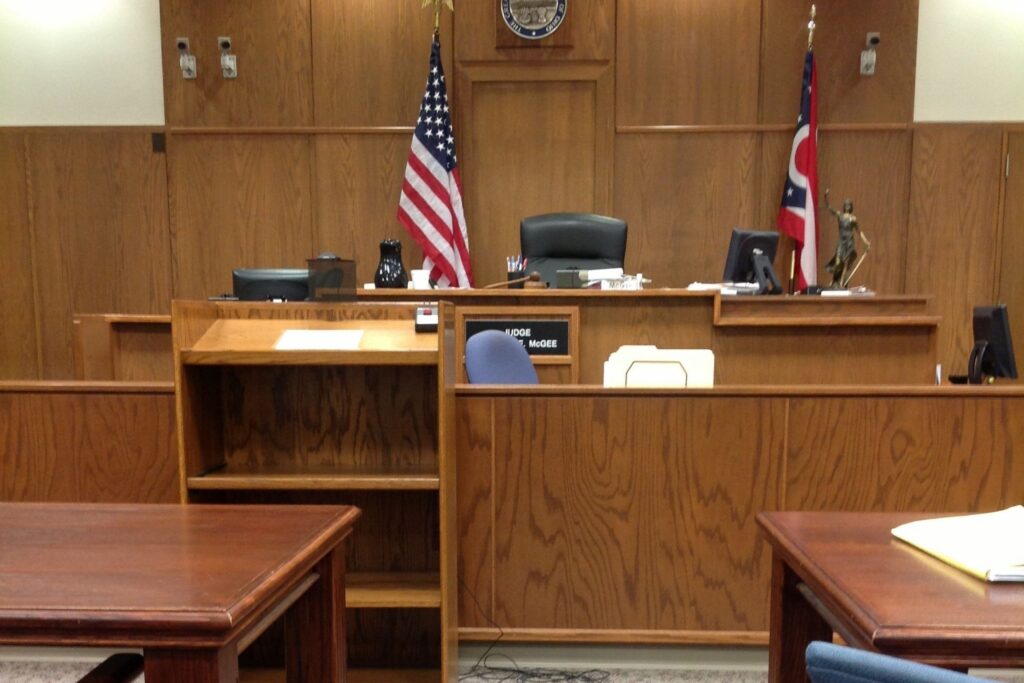
On October 29, 2024, defendant Michael “Mike” Toney was sentenced to an indefinite prison term of eight to twelve years after being found guilty of involuntary manslaughter.
On September 10, 2018, an unresponsive female was found inside her home, and the cause of death was later determined to be a fentanyl overdose.
The victim’s cellphone was collected and taken into evidence but would sit untouched by investigators for over five years. When a forensic download was finally conducted on the phone, text messages between the victim and Toney were discovered. On April 4, 2024, a grand jury indicted Toney on one count of involuntary manslaughter, one count of corrupting another with drugs, and one count of trafficking in a fentanyl-related compound.
On September 11, 2024, Toney’s jury trial was held, and he was found guilty on all three counts. On appeal, Toney raised multiple assignments of error, including that the trial court erred in denying Toney’s Motion to Dismiss for pre-indictment delay.
The Sixth Amendment of the United States Constitution guarantees a speedy trial to a person who has been accused of a crime. The Sixth Amendment provides no protection to those who have not yet been accused; it does not require the Government to discover, investigate, and accuse any person within any particular period of time.
In United States v. Marion, the Supreme Court clarifies, though, that when unjustifiable pre-indictment delay causes actual prejudice to a defendant’s right to a fair trial, despite the state’s initiation of prosecution within the statutorily defined limitations period, the Due Process Clause affords the defendant additional protection.
Courts use a two-part test to determine whether the pre-indictment delay violates due process. First, the defendant must show actual prejudice to the defense, typically through the loss of evidence or unavailable testimony. The claimed prejudice must be specific, particularized, and non-speculative. The burden is extremely demanding; some courts have described it as “nearly insurmountable.”
If a defendant manages to satisfy the first prong of the test, then the burden shifts to the State to prove a justifiable reason for the delay. Pre-indictment delay is typically unjustifiable when done intentionally to gain a tactical advantage over the defendant or when the state, through negligence or error in judgment, ceases an active investigation of a case, but then later decides to commence prosecution upon the same evidence that was available at the time the investigation ceased.
In Toney’s Motion to Dismiss, he asserts only that witnesses are unavailable or have died, and that the defendant cannot recall his whereabouts on the date in question because his memory has faded. The motion further states that the unnecessary delay prevented Toney from locating and preserving necessary evidence.
On review, the Third District Court of Appeals concluded that Toney’s assertions were not specific or particularized and were, instead, speculative. No details are provided as to why the witnesses are unavailable or even which witnesses have since passed away. The Court of Appeals found Toney’s assertion to be nothing more than a general statement. Accordingly, the appellate overruled Toney’s first assignment of error.
Toney’s other assignments of error were denied, as well, and the judgment of the Court of Common Pleas of Seneca was affirmed entirely.
The public may be unfamiliar with the concept of preindictment delay. Prosecutors are, of course, still responsible for bringing charges within the mandatory statute of limitations period. And yet, preindictment delay can obstruct any member of the public’s timely notice of criminal charges, leaving some stunned and others in suspense.
Ohio Court Watch will continue to monitor Toney’s case and report on any future developments should they arise.